
How to Find the Right Esport Coach: A Player's Guide
Not all coaches are created equal. Learn how to evaluate esport coaches, spot red flags, and find someone who will actually help you climb in League of Legends, Valorant, and more.
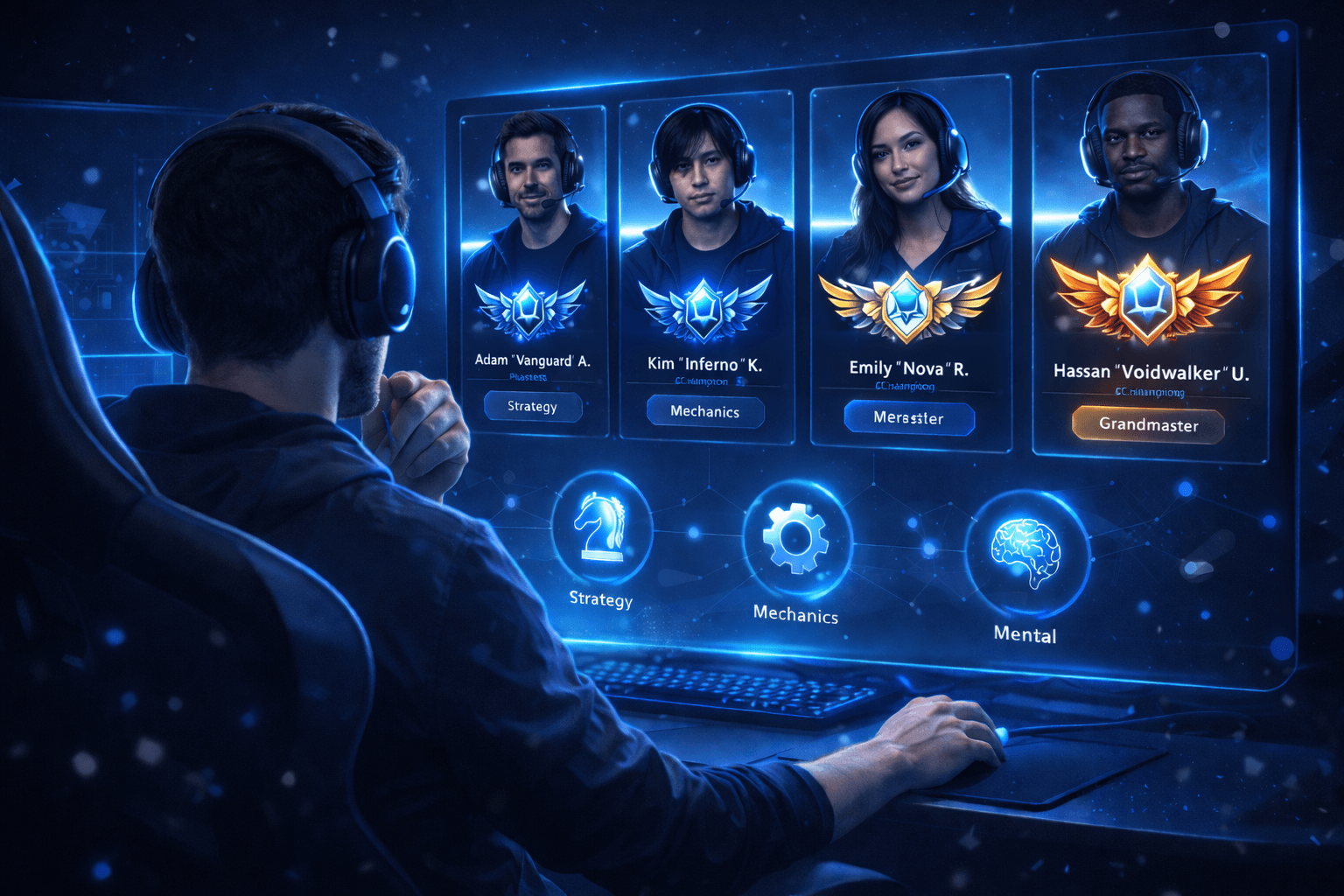
You're stuck. Maybe you've been Gold for three seasons. Maybe you hit Platinum and can't break through to Diamond. You've watched the YouTube guides, copied the builds, grinded hundreds of games — and you're still not climbing.
So you're thinking about hiring a coach.
Good instinct. The right coach can compress months of struggle into weeks of focused improvement. But here's the problem: the wrong coach can waste your money, kill your motivation, and leave you more confused than before.
This guide will help you find a coach who actually fits — someone who understands how you learn, identifies your real weaknesses, and gives you a clear path forward.
Why coaching works (when it works)
Let's be honest: you can reach any rank in solo queue without a coach. People do it every day. But there's a reason pro players, streamers, and high-elo grinders all use coaches.
Coaching accelerates feedback loops.
When you play solo, you might not realize you're making the same mistake for 50 games. A coach spots it in one VOD review. That's not magic — that's expertise applied to your specific gameplay.
Coaching provides external perspective.
You can't see your own blind spots. That's why they're called blind spots. A coach watches your games without the emotional investment you have. They see the patterns you miss.
Coaching creates accountability.
It's easy to autopilot ranked games at 1am. It's harder to ignore your coach's homework when you have a session in two days.
The 5 things to evaluate in any coach
Before you book a session, evaluate every potential coach on these five dimensions.
1. Rank and relevance
Their peak rank matters — but it's not everything.
A Challenger player isn't automatically a great coach for someone in Silver. The skills needed to hit Challenger (insane mechanics, deep game knowledge) aren't the same skills needed to teach fundamentals (patience, clear communication, structured feedback).
Questions to ask:
- What's your current rank? (Not just peak)
- Have you coached players at my level before?
- How recently have you played on an account in my elo?
The ideal coach has played at your target rank recently and has experience coaching players at your current level.
2. Game and role expertise
"I coach League of Legends" is vague. "I specialize in jungle pathing for Gold and Platinum players" is specific.
Types of specialization:
- Role specialists: Know every matchup, every powerspike, every trade pattern for one role
- Macro coaches: Focus on map movements, rotations, objective trading
- Mechanics coaches: Drill combos, improve reaction time, optimize settings
- Mental coaches: Handle tilt, pre-game routines, competitive mindset
Know what you need most right now. If you're losing lane every game, a macro coach won't help as much as a laning specialist.
3. Teaching style and communication
This is where most player-coach relationships fail.
Some coaches teach by explaining concepts. Others teach by asking questions. Some are encouraging; others are blunt. Neither is wrong — but you need to know what works for you.
Red flags:
- They only list your mistakes without explaining the "why"
- They use jargon without checking if you understand
- They get frustrated when you don't immediately improve
- They talk more than they listen
Green flags:
- They ask about your goals before jumping into feedback
- They adjust their explanations when you look confused
- They give you 2-3 actionable takeaways, not 20 criticisms
- They follow up between sessions
4. Format and availability
Coaching isn't one-size-fits-all. Different formats work for different learners.
| Format | Best for | Drawbacks |
|---|---|---|
| Live coaching | Real-time correction, building habits | Expensive, requires schedule alignment |
| VOD reviews | Deep analysis, flexible timing | No immediate feedback during play |
| Session packs | Ongoing improvement, accountability | Commitment required upfront |
| Async reviews | Busy schedules, budget-friendly | Less personal interaction |
Consider your schedule, budget, and learning style. If you only have 2 hours a week, async VOD reviews might beat a single live session.
5. Social proof and track record
Testimonials and reviews matter — but look deeper than star ratings.
What to look for:
- Before/after rank screenshots from real clients
- Video testimonials (harder to fake)
- Specific stories, not generic praise ("He helped me fix my jungle pathing" > "Great coach!")
- Responsiveness to negative feedback
If a coach has no reviews, that's not automatically disqualifying — everyone starts somewhere. But ask for a trial session before committing to a package.
Questions to ask before booking
Come prepared. A good coach will respect you for being serious about the process.
-
"What's your coaching philosophy?"
- Listen for a clear, structured approach — not just "I watch your games and tell you what's wrong"
-
"How do you structure a typical session?"
- Look for: intro, VOD review, key takeaways, homework, follow-up plan
-
"What results have similar players achieved?"
- Specific examples ("I helped a Gold 2 ADC hit Plat 1 in 6 weeks") beat vague claims
-
"How do you handle players who plateau?"
- Good coaches have strategies for this. Bad coaches blame the player.
-
"Can I see a sample VOD review?"
- Many coaches post these publicly. If not, ask for one.
Red flags that should make you run
Not all coaches are worth your money. Avoid anyone who:
Guarantees specific results
- "Diamond in 30 days guaranteed!" — No legitimate coach promises ranks. Too many variables.
Has no clear pricing
- Hidden fees, vague "DM for rates", pressure to commit before knowing costs — all bad signs.
Can't explain their methodology
- If they can't articulate how they coach, they're probably winging it.
Trash-talks other coaches
- Professionals don't need to tear down competitors. This is a sign of insecurity.
Pressures you into big packages upfront
- A confident coach lets their work speak for itself. Start with one session.
How to get the most out of coaching
Once you've found a coach, do your part to make it work.
Before sessions:
- Come with specific questions or goals
- Have recent VODs ready to review
- Write down what you've been struggling with
During sessions:
- Take notes (or record with permission)
- Ask clarifying questions — don't nod along if you're confused
- Be honest about what you do and don't understand
After sessions:
- Actually do the homework
- Apply one thing per game, not everything at once
- Track your progress so you can see improvement
The players who get the most from coaching are the ones who treat it like a partnership, not a service.
What to do if it's not working
Sometimes the fit just isn't right. That's okay.
Signs it's time to move on:
- You dread sessions instead of looking forward to them
- You're not seeing any improvement after 4-6 weeks
- The coach doesn't adapt to your feedback
- Communication feels off
Don't stay out of guilt or sunk cost. A great coach for someone else might not be the right coach for you.
Finding coaches today (and soon, on Skillrift)
Right now, finding a coach means scrolling through Discord servers, Reddit posts, and Twitter DMs. It works, but it's messy.
Skillrift is building something better: a platform where you can browse verified coaches, see their specializations, read real client reviews, and book sessions — all in one place.
Until then, use this guide to vet coaches yourself. Your rank (and your wallet) will thank you.
Looking for your first coach? Start with a trial session. One hour can tell you everything you need to know.
Ready to level up your coaching?
Join our waitlist and be the first to access Skillrift.
Ready to level up your coaching?Related Articles

How to Become an Esport Coach: The Complete Guide for 2026
A step-by-step guide to launching your esport coaching career. From defining your niche to landing your first paying clients in League of Legends, Valorant, and beyond.
Read more →
Why We're Building Skillrift: The Platform Esport Coaches Deserve
Esport coaches deserve better than duct-taping Discord, Calendly, and PayPal together. Here's why we're building Skillrift — and what it means for the future of coaching.
Read more →
The Story Behind Skillrift: From Frustrated Player to Founder
How struggling to find professional coaching as an ADC main led me to build the platform esport coaches deserve. The personal story behind Skillrift.
Read more →